Qwen3 vs Gemma 4 for Local Coding: Which Model Fits Your Hardware?
Compare Qwen3 and Gemma 4 for private C# and .NET coding by memory use, context, tooling and reproducible local tests.
Compare Qwen3 and Gemma 4 for private C# and .NET coding by memory use, context, tooling and reproducible local tests.
Qwen3 and Gemma 4 can both help with local coding. Asking which family is “best” without naming the model size, quantization, context limit, runtime, language, and test set strips away the useful part of the comparison. What remains is mostly horoscope reading for GPUs.
For a C# or .NET developer, the useful question is narrower: which family gives acceptable code and reasoning on the hardware you own, while keeping source code and architectural details on your machine?
The Decision in One Page
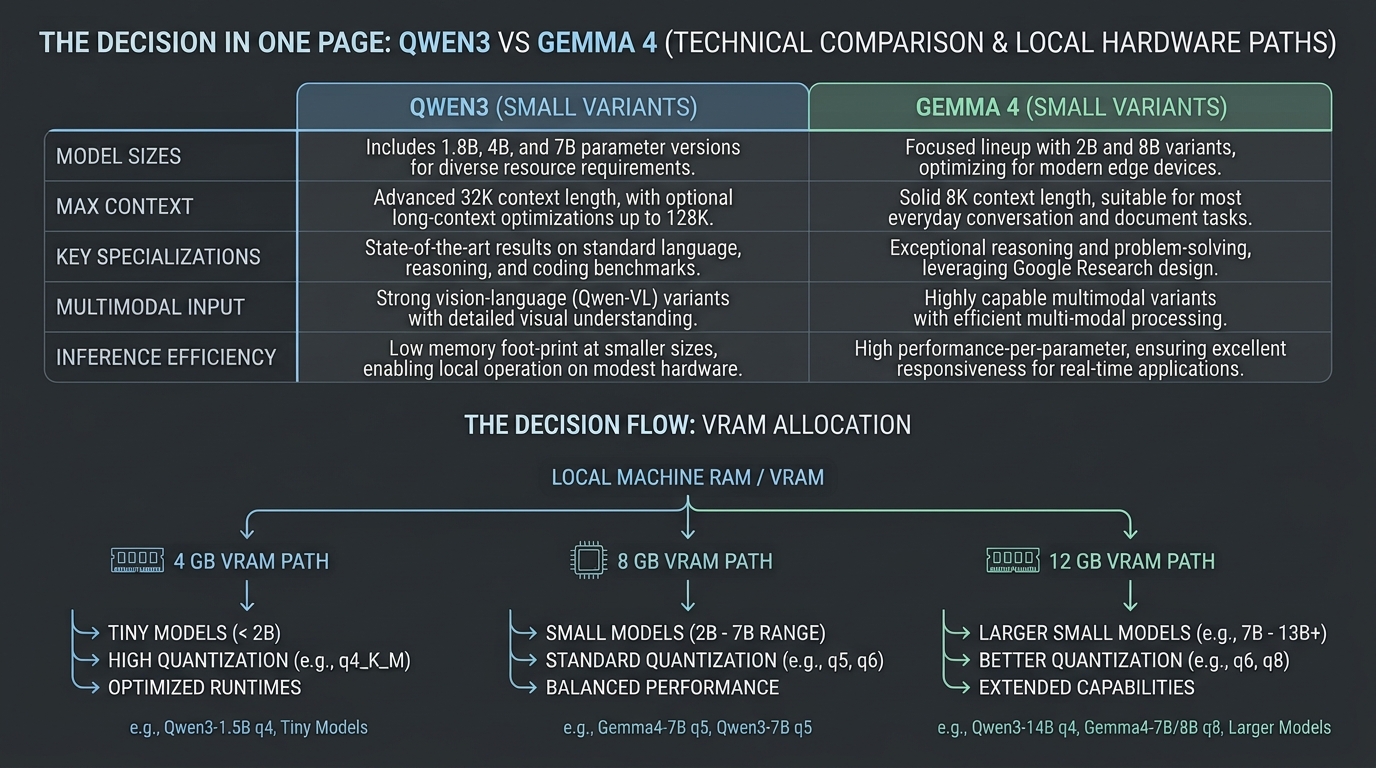
My starting recommendations:
| Hardware | Start with | Why |
|---|---|---|
| 4 GB VRAM | Qwen3 1.7B or 4B-class quant, or Gemma 4 E2B | Leaves room for context and runtime buffers |
| 6 GB VRAM | Qwen3 4B or Gemma 4 E2B/E4B at a suitable quant | Useful coding help without extreme offload |
| 8 GB VRAM | Qwen3 4B/8B quant or Gemma 4 E4B; test Gemma 4 12B carefully | Better quality range, but context still matters |
| 12 GB VRAM | Qwen3 8B/14B quant or larger Gemma variant that measures well | More room for context and concurrent tools |
| CPU-only | The smallest useful quantized model | Privacy remains; latency becomes the trade-off |
These are starting points, not guarantees. Quantization files and runtimes differ. Keep at least several hundred megabytes of headroom and test the actual context you intend to use.
For the low-memory setup process, read How to Run a Local Coding LLM With Only 4GB or 8GB of VRAM first.
What Qwen3 Brings
The Qwen team released dense Qwen3 models at 0.6B, 1.7B, 4B, 8B, 14B, and 32B, plus Mixture-of-Experts variants. The official Qwen3 release lists 32K context for the models below 8B and 128K for 8B and larger original variants. It also recommends local runtimes including Ollama, LM Studio, MLX and llama.cpp.
Qwen3’s practical strengths for a local developer are:
- several small dense sizes;
- established GGUF and local-runtime support;
- thinking and non-thinking behavior in the family;
- strong interest in coding and agent workflows;
- Apache 2.0 licensing for the released Qwen3 models.
The small sizes make Qwen3 easy to scale down. A 4B model is not going to understand a large enterprise solution like a frontier cloud model, but it can review a focused method, explain compiler output, draft tests, and make a useful second pass over an API contract.
Qwen also has coding-specific models and Qwen Code tooling. Do not confuse the capability of a huge Qwen3-Coder model with what fits on an RTX 3050. The family name may be shared; the hardware bill is not.
What Gemma 4 Brings
Google describes Gemma 4 as a family with small effective-parameter models, dense models, and a Mixture-of-Experts option. Its official overview lists E2B, E4B, 12B, 26B A4B and 31B variants, configurable thinking, function calling, and coding improvements.
Gemma 4 also has a meaningful difference: selected variants support native audio as well as text and image input. That does not automatically improve a C# completion, but it can matter if the same local server will later process voice notes, screenshots, diagrams, or smart-home inputs.
Google publishes approximate inference-memory figures, including:
| Gemma 4 variant | Published Q4_0 estimate |
|---|---|
| E2B | 2.9 GB |
| E4B | 4.5 GB |
| 12B | 6.7 GB |
| 26B A4B | 14.4 GB |
| 31B | 17.5 GB |
Those figures include a stated loading overhead in Google’s table, but your context, backend and concurrent services still matter. Gemma 4 E4B looks like a natural small-GPU candidate. The 12B variant may load on an 8 GB card in a tight configuration, yet loading is only the first test.
Dense vs MoE Does Not Mean Small on Disk
Mixture-of-Experts models activate only part of their parameters for each token. That can improve compute efficiency, but all the expert weights still need somewhere to live.
This matters when comparing a model such as Qwen3 30B-A3B with a smaller dense model. “3B active” does not mean the model has the memory footprint of a 3B dense model. The same warning applies to Gemma 4’s 26B A4B variant.
For limited VRAM:
- use total model memory to decide whether it fits;
- use active parameters and backend support to reason about compute speed;
- verify that your runtime implements the architecture efficiently;
- do not buy hardware from the active-parameter number alone.
Sparse models can be excellent on the right machine. They are not a coupon code for VRAM.
Which Is Better for C# and .NET?
There is no defensible family-wide answer. Test the exact variants you can run.
A useful C# assistant needs to handle:
- nullable reference types;
- asynchronous code and cancellation tokens;
- dependency injection scopes;
- ASP.NET middleware and endpoint filters;
- Entity Framework query behavior;
- xUnit or NUnit tests;
- package and target-framework constraints;
- solution-specific naming and layering.
Generic coding benchmarks rarely test your exact combination. They may reward a correct standalone function while ignoring whether the model invented an obsolete NuGet package or violated the repository’s architecture.
My expectation is that a Qwen coding-oriented variant deserves the first test when pure coding is the priority. Gemma 4 deserves a serious test when you want one smaller local model for coding, reasoning, function calls, and multimodal jobs. That is a hypothesis to verify, not a benchmark result disguised as personal experience.
Use a Reproducible Local Test
Create a small private fixture repository that contains no customer data. Use the same commit for every model.
Suggested solution:
LocalModelBench.sln
  src/
    Orders.Api/
    Orders.Application/
    Orders.Infrastructure/
  tests/
    Orders.Application.Tests/
Give each model the same five tasks:
1. Compiler repair
Provide a real compiler error and the two relevant files. Score whether the solution builds without unrelated edits.
2. Async correctness
Ask the model to find a missing CancellationToken, blocking .Result, or incorrectly scoped async operation. Score correctness and explanation.
3. API validation
Provide a minimal endpoint accepting an invalid request. Ask for a fix that matches the project’s existing validation style.
4. Unit testing
Ask for xUnit tests around one service. Score compilation, meaningful assertions, edge cases, and invented APIs.
5. Security review
Include a deliberately unsafe SQL string, mass-assignment issue, or authorization omission. Score whether the model identifies the actual risk without flooding the answer with generic warnings.
Record:
| Metric | Why it matters |
|---|---|
| Builds successfully | Code-looking text is not enough |
| Tests pass | Behavior matters |
| Unnecessary files changed | Measures restraint |
| Invented APIs or packages | Common local-model failure |
| Time to first token | Determines interactive usability |
| Total response time | Captures prompt processing and generation |
| Peak VRAM and RAM | Determines whether the setup is stable |
Run each task at least three times with fixed sampling settings. One lucky answer is not a model evaluation.
Thinking Mode Can Waste a Small GPU’s Time
Reasoning modes can improve difficult tasks, but they also generate more tokens and increase latency. For autocomplete, small refactors, and straightforward compiler errors, use a non-thinking or tightly budgeted mode when the model supports it.
Reserve deeper reasoning for:
- tracing a cross-layer bug;
- planning a migration;
- evaluating competing API designs;
- reviewing concurrency or transaction boundaries.
A model that spends a minute contemplating a missing semicolon is not careful. It is badly configured for the job.
Context Strategy Matters More Than Maximum Context
Qwen3 and Gemma 4 advertise large context windows in several variants. On a local GPU, the maximum supported window should not be your default.
Use a context builder that sends:
- the task;
- repository conventions;
- the active file;
- directly referenced types;
- compiler or test output;
- only the most relevant retrieved snippets.
Start at 4K or 8K. Increase it when a measured task fails because information is missing. This improves latency, memory use, and often answer focus.
For a Visual Studio integration, exclude secrets, generated artifacts, build outputs, large lockfiles, and unrelated migrations. Private inference is wasted if the extension quietly sends telemetry or indexes material that never needed to enter the prompt.
A Safe Local Coding Architecture
Run the model server on loopback:
Visual Studio extension
  -> http://127.0.0.1:8080/v1
  -> local inference runtime
  -> quantized Qwen3 or Gemma 4 model
If several machines need access:
Developer VLAN
  -> authenticated reverse proxy
  -> firewall allowlist
  -> inference server VLAN
Do not expose an unauthenticated Ollama or llama.cpp endpoint through router port forwarding. A local model can still leak source code if its API is reachable by the wrong client.
Keep logs under control as well. Prompt logging is useful for debugging, but a complete prompt history can become a second copy of proprietary code. Set retention intentionally and protect backups.
My Practical Choice
On 4 GB VRAM, I would begin with Qwen3 1.7B or 4B-class quantization and Gemma 4 E2B, then keep whichever performs better on the C# fixture. The winner may change by task.
On 8 GB, I would compare Qwen3 4B or 8B against Gemma 4 E4B first. I would test Gemma 4 12B only after the smaller variant establishes a baseline, because a larger model with CPU spill can feel worse in an editor.
On 12 GB, the search opens up. Qwen3 8B or 14B-class quantizations and larger Gemma configurations become more comfortable, but the same benchmark still applies. More VRAM buys options. It does not remove the need to compile the output.
If the machine will also handle local voice or image input, Gemma 4’s multimodal variants become more attractive. If the machine is a dedicated coding endpoint, Qwen’s coding ecosystem deserves more weight.
Pick the model that passes your repository test with acceptable latency. The sensible result may be keeping both: one for completion and another for longer reasoning or review. A few extra gigabytes of storage cost less than forcing a nuanced comparison to produce one universal winner.
Keep reading
Related guides
Gemma 4 Audio Local Inference: What Works Offline and What Does Not
Test Gemma 4 audio locally for transcription and translation, with realistic runtime, format, memory and latency limits.
How Much Hardware Does a Private ChatGPT Actually Need?
Size CPU, RAM, VRAM and storage for Open WebUI, Ollama, local RAG and multiple users without buying an oversized AI server.
Local RAG With Open WebUI: Chat With Documents Without the Cloud
Build an offline Open WebUI RAG workflow for PDFs with local embeddings, practical chunking, evidence checks and private storage.