Offline Voice Control for Home Assistant With Gemma 4
Design a private voice control stack for Home Assistant using local speech, Piper output, and a constrained Gemma 4 action layer.
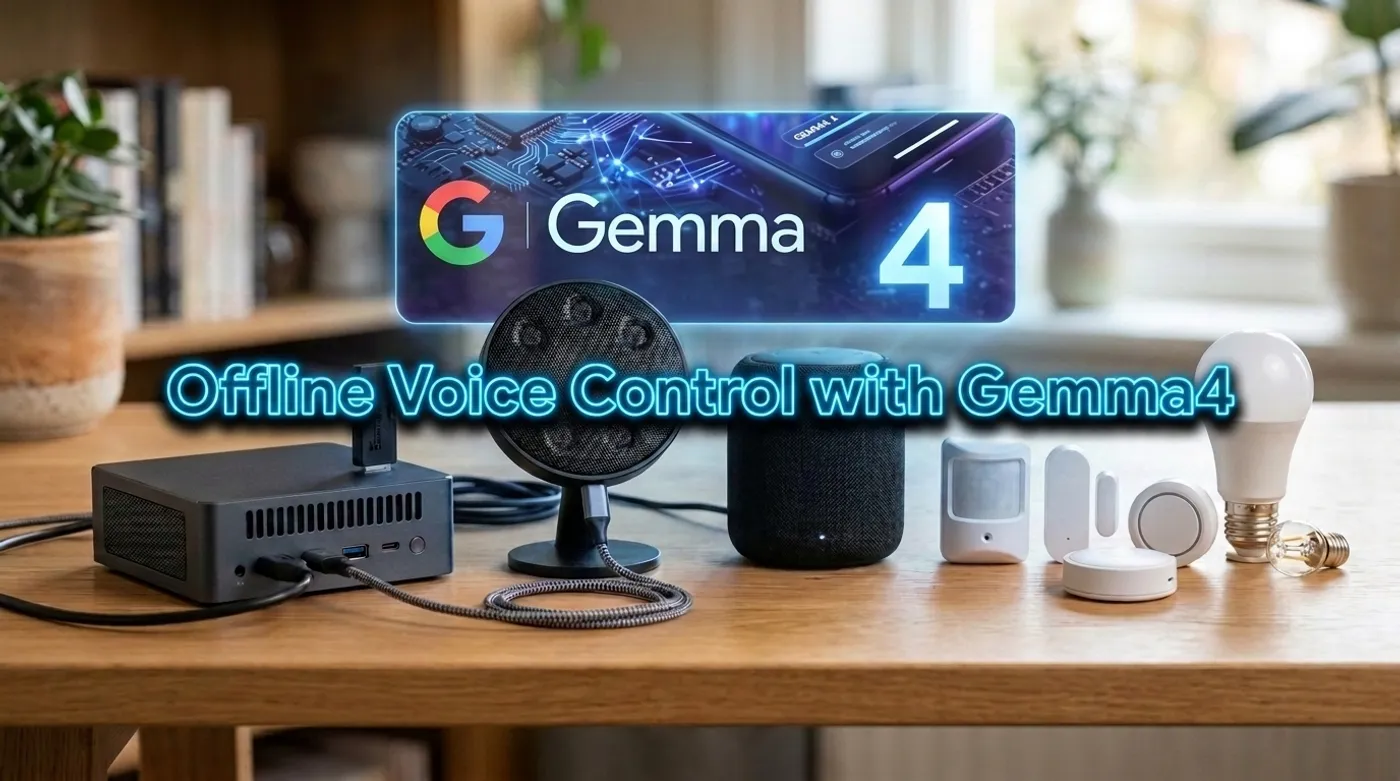
Design a private voice control stack for Home Assistant using local speech, Piper output, and a constrained Gemma 4 action layer.
Voice control is where cloud smart homes feel convenient and local smart homes often feel unfinished. Saying “turn off the kitchen lights” should not require a round trip through a vendor account, but the local alternative has to be fast, accurate, and safe enough that the household keeps using it.
The current Gemma 4 search intent is not generic AI hype. People are asking a practical question: can a local model handle speech-to-action for Home Assistant without depending on the traditional cloud assistant stack? The answer is architecturally yes, but the safest design is not “let the model control everything.” It is a local voice pipeline with constrained actions.
The Offline Voice Pipeline
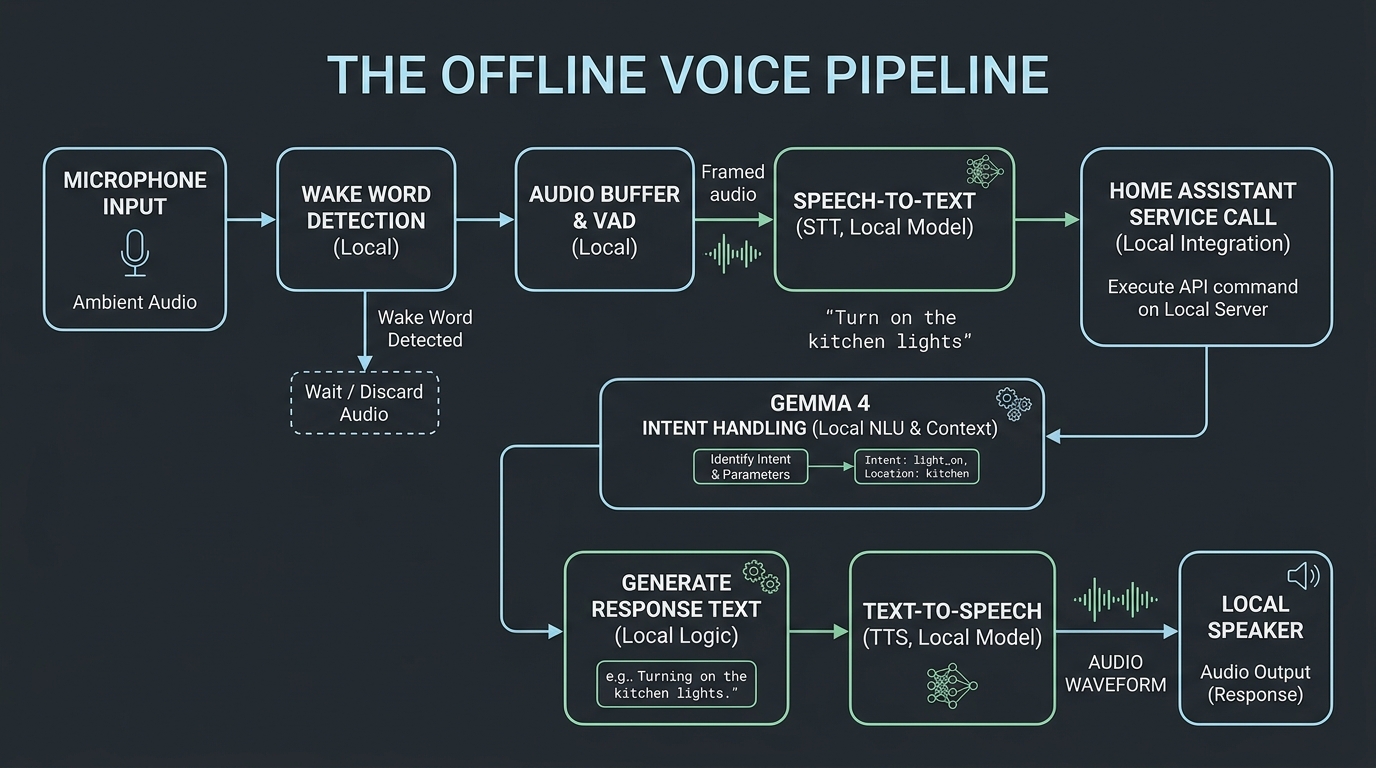
A practical offline stack has five parts:
Microphone
  -> wake word
  -> local speech-to-text or audio-capable model path
  -> Gemma 4-style intent/action layer
  -> Home Assistant service call
  -> Piper text-to-speech response
Rhasspy-style voice control is useful here because it starts from the right assumption: the home should be able to listen, interpret, and respond locally. Piper fits the output side well because it can produce local text-to-speech without handing every response to a cloud voice service.
Gemma 4 belongs in the middle only if it is constrained. It can interpret messy language, choose a safe action, and answer simple household questions. It should not get unrestricted access to the entire Home Assistant API.
Direct Speech-to-Action vs Traditional STT
The report’s top Reddit result points at the most interesting question: can Gemma 4 E2B/E4B-style usage bypass the traditional STT stage and map speech directly to actions?
That is attractive because every extra stage adds latency and failure modes. A classic pipeline looks like this:
audio -> STT text -> intent parser -> action -> TTS responseA direct speech-to-action pipeline tries to compress that:
audio -> model reasoning -> action -> responseThe risk is auditability. Text is easy to log, inspect, and test. Raw audio-to-action can become harder to debug. For a home automation system, I would keep an intermediate transcript or structured intent log even if the model supports audio input. When a light turns on at midnight, you want to know what the system thought it heard.
A Safe Home Assistant Action Layer
Do not expose every entity. Build a tool surface.
Example allowlist:
allowed_actions:
  - name: lights_downstairs_off
    maps_to: script.lights_downstairs_off
  - name: movie_mode
    maps_to: script.movie_mode_living_room
  - name: set_living_room_temperature
    maps_to: climate.set_temperature
    entity_id: climate.living_room
    min: 68
    max: 74
  - name: status_summary
    maps_to: read_only.home_status_summary
This keeps the model away from dangerous improvisation. It can decide that “make it comfortable for watching TV” means movie_mode, but it cannot invent a new action that unlocks a door, disables an alarm, and turns on a heater.
For locks, garage doors, alarms, and high-power devices, require confirmation:
User: unlock the front door
Assistant: I can unlock the front door. Confirm?
User: confirm
Action: lock.unlock front_door
That extra turn is not friction. It is a safety boundary.
Hardware That Makes the Stack Practical
You need three types of hardware: a host, a voice endpoint, and a device network.
The host can be an Intel N100 mini PC, a stronger used business mini PC, or another always-on box that already runs Home Assistant. The exact Gemma 4 model size and quantization will decide how much memory and acceleration you need, so do not buy hardware based on one benchmark screenshot. Start with the smallest usable local model path and upgrade only when latency becomes the measured bottleneck.
For voice endpoints, options include:
- a USB microphone connected near the assistant host
- a ReSpeaker-style USB microphone array
- an ESP32-S3-BOX-3 class satellite
- a small USB speaker for local responses
- a Zigbee button as a non-voice fallback trigger
For devices, keep the control layer local. A Sonoff Zigbee 3.0 USB Dongle Plus gives Home Assistant a local Zigbee network for sensors, switches, and plugs. That matters because a private voice assistant is less useful if every action still depends on a vendor cloud device.
Network Placement
Keep the assistant infrastructure on a server or infrastructure VLAN:
Main LAN:      10.10.0.0/24
Servers:       10.20.0.0/24
IoT devices:   10.40.0.0/24
Voice clients: 10.50.0.0/24
Representative placement:
- Home Assistant:
10.20.0.20 - Local model host:
10.20.0.30 - Voice satellite:
10.50.0.21 - IoT Wi-Fi devices:
10.40.0.0/24 - Zigbee devices: behind coordinator, no IP address
Firewall logic:
- voice clients can reach the local voice service
- local model host can reach Home Assistant API
- IoT devices cannot reach the main LAN
- Home Assistant can reach only the device networks it needs
- no voice audio is sent to public cloud services unless explicitly enabled
This layout keeps the voice stack useful without giving every microphone a path to personal laptops and storage.
What Should Stay Deterministic?
Keep critical automations deterministic:
- water leak shutoff
- smoke or CO alerts
- door lock rules
- garage door close logic
- heater shutoff
- alarm arming/disarming
The model can explain these automations, summarize their state, or help write drafts. It should not be the only component deciding whether a risky action happens. Local AI is good at interpretation. Deterministic automation is still better for safety.
Testing Before the Household Uses It
Before making the assistant available in shared rooms, test with harmless actions:
- turn on one lamp
- read one temperature sensor
- run one scene
- ask for a room status summary
- trigger a notification
Then test failure cases:
- internet disconnected
- Home Assistant restarted
- model service stopped
- microphone offline
- ambiguous room names
- wrong wake word detection
The system should fail closed. If the model is down, lights should still work from switches, dashboards, and deterministic automations. If the microphone mishears a command, the action should be limited enough that the mistake is annoying, not dangerous.
Where Gemma 4 Helps Most
The best local AI assistant is not the one that controls the most devices. It is the one that reduces friction without weakening the house.
Useful jobs:
- convert fuzzy language into safe scripts
- answer “what is on upstairs?”
- summarize why an automation fired
- suggest cleaner automations
- produce a spoken Piper response
- keep logs of interpreted commands
That is enough to make the home feel smarter without turning it into an experiment nobody trusts. The local-first rule stays the same: the house should keep working when the internet is gone, and the model should make that system easier to use, not harder to reason about.
Keep reading
Related guides

Reduce Food Waste With Local OCR, Private RAG and Fridge Photos
Turn fridge photos into a private local inventory with OCR, recipe retrieval and honest date-label alerts that require confirmation.
Why Local Home Automation Gets Better With a Local AI Layer
Use Home Assistant, Zigbee, and a local Gemma 4-style model to make home automation more private, resilient, and useful.
AI Energy Management With Home Assistant and EMHASS
Use EMHASS with solar forecasts, dynamic tariffs, EV charging constraints and deterministic Home Assistant fallbacks.